
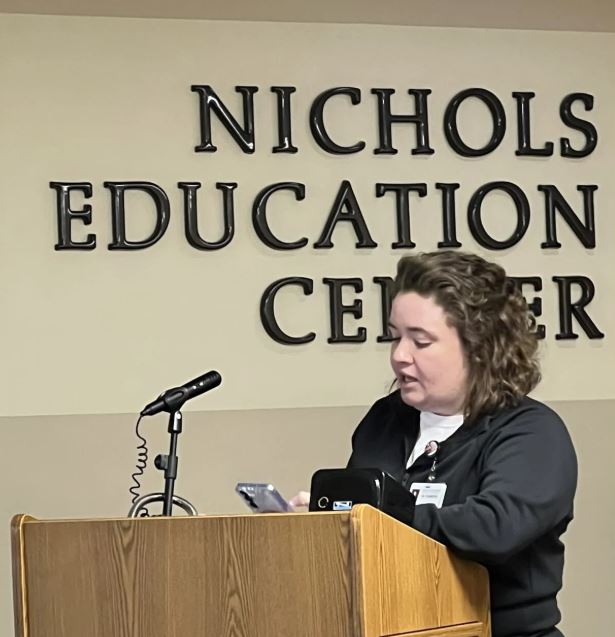
Memorial Health System continued its new monthly community health education series with a presentation by Dr. Allison Thompson, a family medicine physician at Memorial Health System, about colorectal cancer screening.
Thompson presented a program Feb. 9 in advance of March, which is recognized as colorectal cancer awareness month.
She noted that the Tammy Walker Cancer Center will give away 800 free take-home colorectal cancer screening kits to anyone ages 45 to 75.
Colorectal cancer remains one of the most common and deadly cancers in the United States.
“It’s the third most common cancer in both men and women, and the third most common cause of cancer deaths in men and women,” Thompson said.
Unlike many other cancer screenings, colorectal screening can prevent cancer from developing.
“A lot of screens that we have for different cancers … we’re only checking to see if there’s cancer there,” she said. “Colorectal cancer goes a step beyond that.”
During a colonoscopy, physicians can identify and remove polyps — growths that could eventually become cancerous — before they turn into cancer.
“If you took 1,000 people… about 80 of them are going to be diagnosed with colorectal cancer at some point,” Thompson said. “If they do not have a screening, 30 of those people will die from cancer. If they do undergo regular screening, we can get that number of deaths all the way down to five, which is pretty darn amazing.”
Screening guidelines have also changed in recent years. The recommended starting age has dropped from 50 to 45.
“We’re finding that it’s a much more common cancer in younger groups than it used to be,” she said.
Screening options explained
Thompson outlined two general categories of screening tests: one-step tests and two-step tests.
The only one-step test is a colonoscopy, which allows doctors to view the entire colon and remove polyps during the same procedure.
“That is the gold standard, because it’s the most thorough, it’s the most active in all the forms of screening,” she said.
Four general surgeons from Salina travel to Atchison to perform colonoscopies locally, increasing convenience for patients.
Two-step testing begins with a screening test. If results are abnormal, a colonoscopy follows.
Stool-based options include:
• FIT (fecal immunochemical test): Detects microscopic blood in the stool and is done annually. There is no preparation required.
• Stool DNA test (such as Cologuard): Detects DNA from cancer cells. If normal, it is repeated every three years.
• FOBT (fecal occult blood test): Requires three stool samples and some dietary changes. It is done annually but has become less common due to convenience factors.
Additional options include flexible sigmoidoscopy, which examines the lower third of the colon, and CT colonography, a specialized scan performed every five years.
What to expect during a colonoscopy
Many patients are hesitant about colonoscopies because of the bowel preparation required beforehand.
“If there’s anything bad about a colonoscopy, it tends to be the prep that people are nervous for,” Thompson said.
However, she emphasizes that the temporary discomfort is worth the benefit.
“It’s definitely worth having one bad day to prevent a lifetime of cancer,” she said.
During the procedure, patients are sedated.
“You will have been given medicine that will help with any pain, or… even any memory of the procedure itself,” Thompson said.
Symptoms and risk factors
Colorectal cancer often presents with no symptoms, which is why routine screening is critical.
“People may feel totally fine or have nothing at all,” Thompson said.
Symptoms that warrant medical evaluation include blood in the stool, changes in bowel habits or stool shape, abdominal or rectal pain, unexplained weight loss and new anemia.
She also emphasized that screening guidelines apply to individuals without significant family history or symptoms. Patients with additional risk factors may need earlier or more frequent screening.
Encouraging patients to take the lead
Ultimately, Thompson hopes residents will feel empowered to take an active role in their health care.
“We don’t do colonoscopies to torture patients, but truly to help prolong their life and prolong a healthy life,” she said.
She encourages patients to discuss options, risks and benefits with their primary care providers and to maintain healthy lifestyle habits, including a balanced diet, regular physical activity and limiting tobacco and alcohol use.
“My hope is that patients kind of sit more in the driver’s seat for their health,” Thompson said.
Recognizing signs of sepsis
The next free health education session will feature
Dr. Kimberly Hinman who will speak about the dangers of sepsis. Learn to recognize the signs and symptoms, understand who is at risk and discover how early treatment can save lives.
The session is from 5:30 to 7:30 p.m., Monday, March 9 at the Nichols Education Center, 1003 N. Brady — in the basement of Abilene Childcare Learning Center, people should enter through the back door.
Snacks and drinks will be provided.